tGBP is a regulated, fully backed pound stablecoin issued by BCP Technologies, and it was one of the first tokens to launch a confidential version on the Zama Protocol. It has about $5 million shielded in its confidential vault, curated by Steakhouse on Morpho.
In this conversation, Kyle O'Brien, VP of Capital Markets at Zama, sits down with Benoit Marzouk, CEO of tGBP, and Zama CEO Rand Hindi to discuss why a regulated stablecoin went confidential so early, why global companies need multi-currency rails onchain, how confidential issuance and a confidential FX market unlock the next billions of shielded TVL, and why trillions are the new billions.
Watch the full conversation, or read the transcript below.
Edited transcript
Kyle O'Brien: I cannot help but notice you have a French name and a French accent. How did you get into the GBP stablecoin world, and how does tGBP work under the hood?
Benoit Marzouk: Despite my accent, I have been in London for 15 years, previously in investment banking, so my life is here. I was a trader for nine or ten years, and in 2017 I founded BCP Technologies. Historically it was an exchange, and we pivoted into a GBP stablecoin around 2023. The killer use case of blockchain is really stablecoins. The first use case for USDT was arbitraging the Bitcoin price between Japan and the US: transferring money without the volatility. As an exchange, I shared the view that you would not only have dollar-denominated stablecoins. Like many great things, it starts in the US and then it expands. As for the mechanics, tGBP is fully backed one-to-one. Under the incoming regulation you can hold three asset classes: cash, treasury bills, meaning gilts, or eligible money market funds. We follow these rules and we are quite conservative, so a large chunk is cash.
Kyle O'Brien: Rand, what excites you about getting a non-dollar stablecoin into the Zama Asset Registry? It is not obvious we would replicate fiat currencies in stablecoins; we are inventing new internet money. Why is it important to have USD, GBP and euro stablecoins?
Rand Hindi: Take Zama as an example. We are a French-Swiss company with a lot of operations in the US, and contractors and team members in the UK. Our treasury and operations run in euros, dollars, Swiss francs and pounds. If we want to move all of that onchain, we either do not do it onchain, or we convert to dollars to pay people in pounds or Swiss francs, and they convert back. You pay the exchange rate twice, plus the off-ramp fees. It is a very inefficient way to use a currency. Any global organization, which is pretty much every blockchain company, needs a multi-currency payment system, and that is exactly what this brings. Beyond payments, depending on the macro context, there may be reasons to hold more GBP than dollars. If you want finance to move onchain, you need to create this breadth of options for investors and for companies.
Kyle O'Brien: You are much earlier in your journey as a token issuer than Tether or Circle. What motivated you to build a confidential version of the token so early and work with Zama, when you are regulated and there are complexities around compliance and transparency?
Benoit Marzouk: Back in 2021, when we became FCA registered as an exchange, the FCA expressed concern about privacy coins such as Monero, for all the money-laundering risk and the fact that transactions would be hard or impossible to trace. Public blockchains were great for tracking criminals. But for any enterprise use case, for capital markets, for larger corporations, and even at a smaller scale, a company like ours with a dozen employees, you cannot really pay salaries on a public blockchain. Every colleague would see. So you need a confidential layer, and that is what I love about Zama. When the Zama team pitched me, two things stood out. First, it is a layer on existing blockchains, and Ethereum still represents the majority of the stablecoin market cap. Second, Zama is building all the tools needed to stay in line with compliance and regulatory requirements. I embraced it straight away, and we built the confidential version last summer.
Rand Hindi: That is a really important point. People still sometimes think of blockchain as a parallel ecosystem where the rules of traditional finance might or might not apply. I do not agree. Blockchain is becoming just finance, and you have to align with the best practices that have existed in off-chain finance forever: compliance, regulatory posture, conservative strategies. As much as I love the early days of crypto, the test-in-production type of financial products, if you want to onboard trillions and institutional capital, you have to do it the way traditional finance does it, using blockchain for the advantages it brings. Zama made a very clear choice. We built a solution for onchain compliant finance, because the market for compliant finance is orders of magnitude bigger than the market for dark finance. We picked our camp, and our camp is where the business actually is.
Kyle O'Brien: You mentioned payroll, B2B payments, cross-border payments, treasury management. We now have a vault where you can deposit tGBP confidentially and earn yield on it. Who are your primary users, and was there demand from tGBP holders for yield?
Benoit Marzouk: All of them. The obvious use case is a UK institution that wants to be GBP-denominated. But even at the individual level, if you pay for a coffee at Starbucks, you do not necessarily want people to know what is in your wallet. So we have a universal stablecoin, like USDC from Circle, with different verticals. And yes, there was demand for yield. A regulated stablecoin cannot pay a yield. So as an infrastructure company we need to expand into other solutions, and that is where lending protocols bring very interesting, permissionless products. Steakhouse, the vault curator, launched a tGBP market on Morpho. From day one we saw adoption: you pledge your digital assets, wrapped Bitcoin, digital gold, and deposit confidential tGBP against them in a confidential way. That is a game changer.
Kyle O'Brien: We have had a lot of traction on the vaults, and we launched a confidential RFQ, effectively a swap product. As we expand liquidity across trading pairs, is there an opportunity to build a stablecoin FX market on it?
Rand Hindi: Of course. The RFQ protocol we built is great for FX, because it lets you receive quotes from multiple market makers and hide the direction of your trade, or even the asset you are trading, which is very common in RFQ for FX in traditional finance. It was difficult to do onchain until now because you could not hide the settlement. Now you can build an end-to-end confidential RFQ for FX. We are going after larger trades, on the boundary between RFQ and OTC, as opposed to swapping $5 for a coffee on a trip abroad. The way you swap $5 is not the way you swap $100,000 or $100 million, and there are more solutions for small swaps than for large ones. The key thing is liquidity, and that is what we are working on.
Kyle O'Brien: Today you connect your wallet and shield your assets, there is a public shielding event, and everything after that is private. One way to onboard confidentially is to issue tokens in confidential form to begin with: instead of an ERC-20 tGBP, issue natively as ERC-7984, the confidential token standard. Have you thought about confidential issuance?
Benoit Marzouk: Absolutely. We are working on this with Zama, because it solves the issue of shielding from non-confidential into confidential: at that moment, everyone sees a balance. Issuing directly into confidential tGBP makes total sense.
Rand Hindi: Today this is the major blocker for shielded assets to reach billions of TVL, for two reasons. First, if you want really good privacy, the on- and off-ramp between shielded and non-shielded assets has to be confidential. If you wrap a million dollars of USDC or tGBP into the confidential version, everybody sees it. So you want the issuer to mint directly, or at least handle the conversion, so nobody knows who shielded how much. Second, liquidity. If you want a deep FX market, or a deep market between tGBP and tokenized stocks, market makers need to manage an inventory of shielded tGBP easily. If they have to go and get some and shield it, that leaks the trade. So market makers must be able to source and swap tGBP in and out confidentially. Whether through fiat ramps, exchange ramps, or a liquidity pool the issuer offers directly, the confidential on- and off-ramp is a fundamental piece of building liquidity.
Kyle O'Brien: Where does tGBP mostly sit today? And for a pension fund or a bank, how important is it that the confidential version works inside the infrastructure they already use?
Benoit Marzouk: Mostly on centralized exchanges such as Coinbase and Kraken. Onchain it is mostly on Base, across Uniswap and Aerodrome, and on Orca pools on Solana. Liquidity is a chicken-and-egg problem: you cannot get liquidity without volume, and you cannot get volume without liquidity. It requires partners who believe in your vision, such as Zama. As for the infrastructure, it is not negotiable. Regulation is the first part. But we have been speaking with banks and asset managers, we have dedicated people on that vertical, and with all the problems of collateral management, this confidentiality layer is a game changer. They absolutely need it.
Kyle O'Brien: Rand, how have conversations with token issuers evolved over the past year? Without confidential volume, it is hard to convince issuers, custodians or exchanges that integrating is worth it. When you reach volume, the conversation changes.
Rand Hindi: Very different. Everybody now understands that confidentiality is required for finance to move onchain. We knew that, but it became even more obvious over the past 12 months as people actually demanded it. Zama today is by far the fastest-growing privacy protocol for public blockchains. We launched the first confidential vault three months ago, we now have 16, including tGBP, and in three months we have added more shielded TVL than any other privacy protocol in over a year. The difficult part was getting started, and we were fortunate to have partners who believed in what we believe before there was anything to prove it works. Today the conversation is much simpler, because it does work: we have $127 million in the protocol. That is still a speck compared to the trillions moving onchain, but it is three months with a limited product set. Imagine how quickly that grows once we are integrated into every wallet, custody solution, exchange and on- and off-ramp, once we offer deep liquidity for FX, once we start doing RWAs, once there are a million vaults to earn yield on your tGBP rather than one or two. That is the four-year goal.
Kyle O'Brien: At the risk of asking for an endorsement: you were one of our earliest customers, before Zama even went live. What was the experience of bringing confidentiality into the product?
Benoit Marzouk: I embraced it as soon as I got the pitch. It was a revelation. I saw the solution as what the market needs, and I drew the parallel with HTTPS and the secure internet. I am confident Zama will continue to grow, and I am delighted to see you extending to new chains such as Solana. As you know, Baillie Gifford is going to issue a native money market fund on Solana, and other asset managers plan to do it on the GBP side next year. I am confident you will see a big shift of traditional finance use cases onto public blockchains, using the confidential layer provided by Zama.
Kyle O'Brien: We are just off the conference circuit, KBW and Token2049. Two things stood out: traditional finance moving onchain looks more and more inevitable, fewer t-shirts and more suits, and privacy and compliance were hot topics, which historically were not the sexiest. What do you expect over the next six to twelve months?
Rand Hindi: First, I think we get over a trillion dollars of assets onchain. It is only 3x from where we are; that is almost the bear case. Trillions are the new billions in onchain finance. If a protocol tells you it has a billion of TVL, you will say, okay, but there is a trillion, so you have 0.1% of the market. Second, vaults are going to be massive in driving adoption over the next 12 to 24 months. In traditional finance, if I have $10 million and want yield, I go to five banks, and each has maybe ten products to offer. A position in a yield product at bank A cannot be used as collateral or composed with bank B. Blockchain solves that. With an onchain vault you have liquidity as an LP, you can sell or trade your position any time, which removes the friction of being locked up. And vaults are composable: take strategy A and strategy B and create a third that combines them, portfolios of strategies you can rebalance like a portfolio of stocks. You cannot do that in traditional finance. The number of ways to earn yield onchain is exponential and takes a few lines of code. We are going to have millions of vaults, with agents building them on the fly depending on your risk preferences.
Benoit Marzouk: And the beauty of stablecoins is being able to get out of the position at any time, on weekends, on bank holidays. For that you need currency rails on the blockchain, such as tGBP. For the future, we aim to reach a billion of market cap by the end of next year, with half of it confidential tGBP, which is the game changer for the industry.
Rand Hindi: Half is a good starting point. We should aim for 95% eventually. As confidentiality becomes more common and cheaper, the question becomes: why not? What would be a reason for someone not to shield their assets?
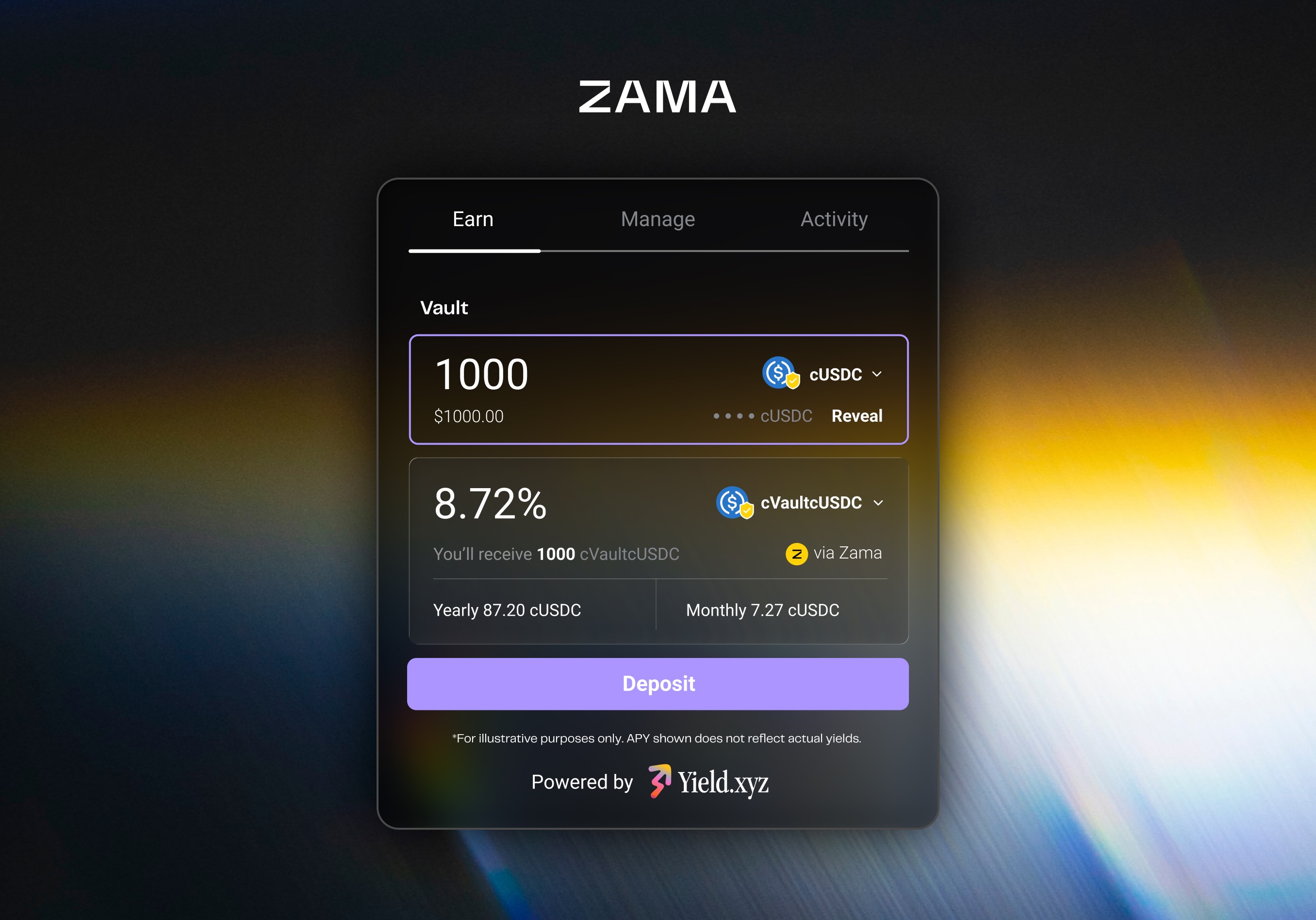
The confidential tGBP vault, curated by Steakhouse on Morpho, is live in the Zama app.
Disclaimer: This content is for informational purposes only and does not constitute financial advice or an endorsement of any vault.
News, research and product releases
Protocol

Solutions
PRODUCTS
Resources
community
company